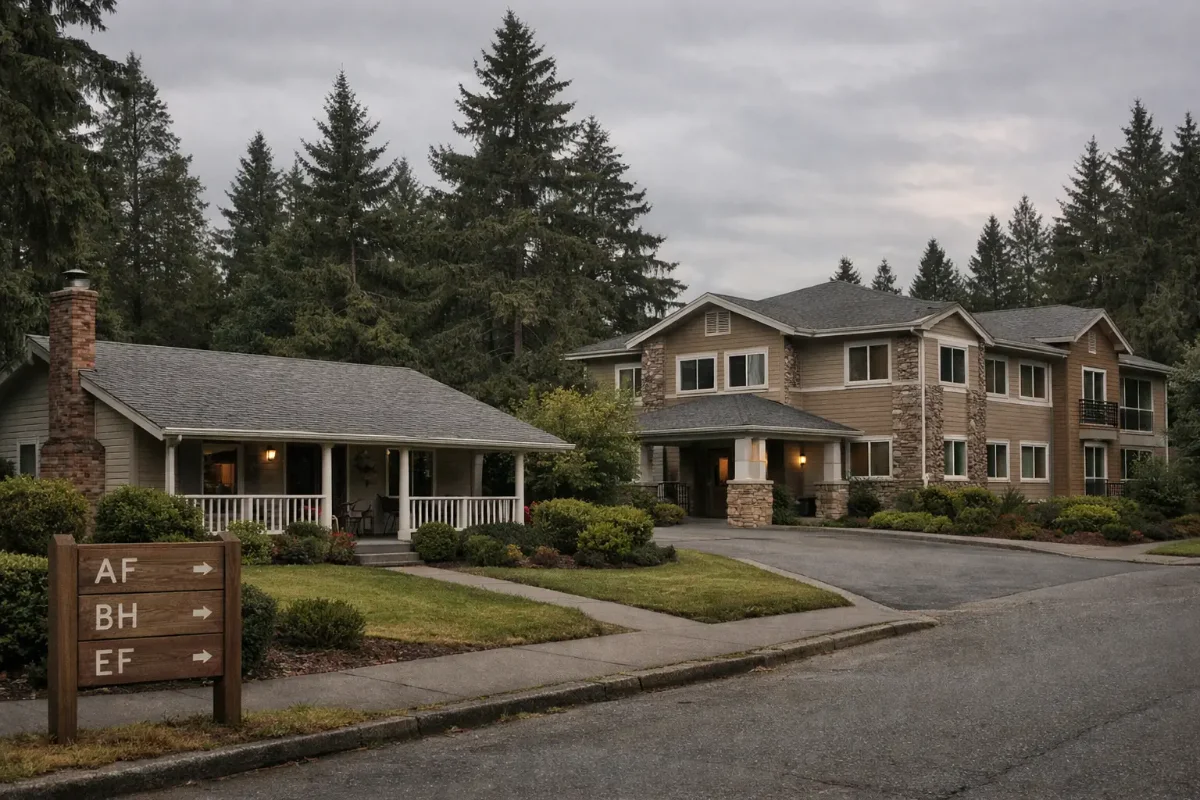
AF, BH, SL, EF, GT, GH: What Washington's DSHS Facility Codes Actually Mean
If you've ever pulled up a facility on the DSHS website and seen a two-letter code like "BH" or "AF" next to its name, you're not alone in wondering what it means. Washington's Department of Social and Health Services classifies every licensed residential care facility into one of six types. Each code maps to a different kind of home, a different population, and a different regulatory framework.
Here's the breakdown.
AF -- Adult Family Home
Adult family homes are regular houses in residential neighborhoods, licensed to care for 2 to 6 adults.1 The provider lives in or operates the home and offers room, board, laundry, supervision, and help with daily activities like bathing, dressing, and medication management. Some AFHs provide nursing care or specialize in dementia, mental health, or developmental disabilities.
The small size is the defining feature. With a maximum of six residents, AFHs have the potential to offer more personal attention than larger facilities due to better staffing to resident ratios. Some cost less than assisted living communities, and they feel less institutional. The tradeoff is fewer systems, amenities, and support that a larger team or organization can bring to the table.
Washington has thousands of licensed adult family homes -- they outnumber every other facility type on this list.1
BH -- Boarding Home (Assisted Living Facility)
This is the one that confuses people. DSHS still uses the code "BH" in its data systems, but the official name changed from "boarding home" to "assisted living facility" in 2012.2 If you see "BH" on a DSHS lookup page, it means assisted living.
Assisted living facilities serve 7 or more residents in a community-based setting.3 They provide housing, meals, laundry, 24-hour staff, and varying levels of personal care assistance. Many offer specialized memory care units for residents with Alzheimer's or other forms of dementia.
Facilities that contract with Medicaid offer three tiered service packages, ranging from basic assistance to more intensive support.3 Bed counts vary widely -- from small homes just above the 7-resident threshold to large communities with 150+ beds.
When families talk about "assisted living," this is the category they mean. It's the most common facility type for seniors who need daily help with activities of daily living but don't require the round-the-clock nursing care that a skilled nursing facility provides.
EF -- Enhanced Services Facility
Enhanced services facilities are a newer category, authorized under Chapter 70.97 RCW.4 They exist for people whose behavioral and personal care needs are too complex for a standard assisted living facility or adult family home, but who don't need to be in a psychiatric hospital.
ESFs serve a maximum of 16 residents.4 Residents are typically referred after leaving state or community psychiatric hospitals, or when no other licensed setting can accommodate their combination of behavioral health challenges, medical needs, and chemical dependency issues. Staffing ratios are higher than other residential settings, with a heavy emphasis on behavioral interventions alongside personal care and nursing services.
There are very few ESFs in Washington. This is a niche category for a specific population.
SL -- Supported Living
Supported living isn't a facility in the traditional sense. Under this model, individuals live in their own homes -- alone or with one to three other people -- and receive contracted support services.5 They pay their own rent, buy their own food, and manage their own personal expenses. A support provider helps with daily living skills, community access, and whatever else the person needs to live independently.
SL is administered through the Developmental Disabilities Administration (DDA), not the same branch of DSHS that handles assisted living and adult family homes.5 It's designed for adults with developmental disabilities who want to live as independently as possible while still having access to help.
GT -- Group Training Home
Group training homes serve 5 to 12 adults with developmental disabilities in a shared residential setting.6 They're operated by nonprofit providers and are not licensed in the same way as assisted living facilities or adult family homes. Staff provide habilitation services -- skills training, community activity support, meal planning, medication management, and medical appointment coordination.
Residents pay room and board through income-based cost-of-care fees and receive a monthly personal allowance.6
The "training" in the name is the key distinction. These homes focus on building residents' skills and independence, not just providing custodial care.
GH -- Group Home
Group homes look a lot like group training homes -- same 5 to 12 resident capacity, same shared living arrangement, same services.6 The difference is regulatory: group homes are licensed facilities and can be operated by either for-profit or nonprofit providers. Group training homes are unlicensed and restricted to nonprofits.
Both fall under the DDA and serve adults with developmental disabilities.6 Both have specific requirements around home layout and safety. From a resident's day-to-day perspective, the experience is similar.
How These Categories Overlap
It's worth noting that these codes don't cover every senior housing option. Independent living communities and continuing care retirement communities (CCRCs) aren't licensed by DSHS, so they don't appear in the facility lookup system at all.3 Nursing homes (skilled nursing facilities) are a separate licensing category.
The six codes above represent the facilities that DSHS actively licenses and inspects through its Residential Care Services division and Developmental Disabilities Administration.
If you're searching for care for a family member, start by figuring out which category fits their needs:
- Seniors who need daily help -- look at BH (assisted living) and AF (adult family homes)
- Adults with developmental disabilities -- look at GT, GH, and SL depending on the level of independence
- Complex behavioral health needs -- EF may be the right fit, though availability is limited
From there, dig into the inspection reports. Every licensed facility has them, and they tell you more about actual quality than any marketing brochure.
SeniorAIQ tracks licensed facilities across Washington State using data from DSHS. We score inspection reports and collect public reviews so families can compare facilities using real data, not just promises.
Sources
-
About Adult Family Homes, Washington DSHS ↩︎ ↩︎
-
Chapter 18.20 RCW: Assisted Living Facilities, Washington State Legislature ↩︎
-
Long-Term Care Residential Options, Washington DSHS ↩︎ ↩︎ ↩︎
-
Enhanced Services Facilities, Washington DSHS ↩︎ ↩︎
-
Understanding Residential Options, DD Ombuds ↩︎ ↩︎
-
Community Residential Services for Adults, Washington DSHS DDA ↩︎ ↩︎ ↩︎ ↩︎