Who Owns each Assisted Living community in King County?
We pulled Washington Secretary of State filings for 70 King County senior housing facilities to answer a question most families never ask: who actually owns this place?1
The answer may not be what you'd expect.
Entity types
Every licensed facility is operated by a legal entity registered with the state. Here's how they break down:
| Entity Type | Count | Avg Years in Business |
|---|---|---|
| WA LLC | 37 | 9.7 |
| Foreign LLC (registered out-of-state) | 19 | 6.6 |
| WA Nonprofit | 8 | 46.8 |
| Foreign LP / Foreign Corporation | 4 | 4.0 |
| WA Profit Corporation | 2 | 26.0 |
Two things stand out initially. First, nonprofits have been around dramatically longer than any other entity type -- 46.8 years on average. Fred Lind Manor's nonprofit was incorporated in 1945. Crista Ministries dates to 1948. These are organizations that have been running senior housing for decades.
Second, foreign LLCs (entities incorporated outside Washington) average 6.6 years -- the youngest category after foreign LPs and corporations. Several were formed within the last two years.
Where the owners are
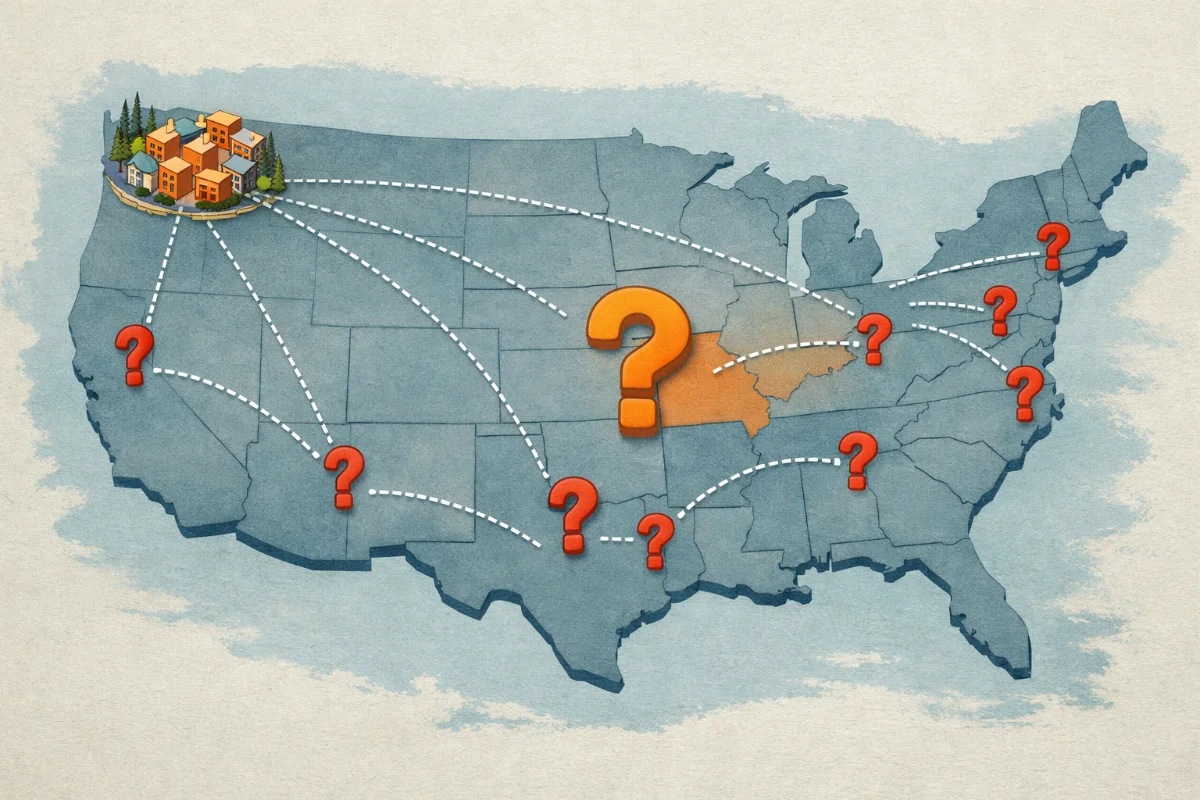
Of the 70 entities we traced, 46 are headquartered in Washington. The other 24 are spread across the country:
| State | Entities |
|---|---|
| Washington | 46 |
| Ohio | 7 |
| California | 4 |
| New Jersey | 2 |
| Florida | 2 |
| Massachusetts | 2 |
| South Dakota | 2 |
| Tennessee | 2 |
| Texas, Arizona, Kentucky | 1 each |
Ohio's 7 entities all trace back to the same address in Toledo -- Welltower Inc., a publicly traded healthcare REIT. That's a single corporate owner showing up as multiple legal entities, each tied to different facility properties. This kind of structure is common in institutional real estate: one parent company, multiple special-purpose entities.
Old guard vs. new money
The age spread is significant:
Longest-operating entities:
| Entity | Type | Incorporated |
|---|---|---|
| Fred Lind Manor | WA Nonprofit | 1945 |
| Crista Ministries | WA Nonprofit | 1948 |
| Bayview Manor Homes | WA Nonprofit | 1958 |
| Horizon House | WA Nonprofit | 1960 |
| Kin On Health Care Center | WA Nonprofit | 1993 |
Newest entities:
| Entity | Type | Incorporated |
|---|---|---|
| Bellettini Propco LLC | Foreign LLC | Nov 2025 |
| VGFW Propco LLC | WA LLC | Jun 2025 |
| Parkside Propco LLC | WA LLC | May 2025 |
| FC Kent Senior Living LLC | Foreign LLC | Apr 2025 |
| Queen Anne ALC LLC | WA LLC | Jan 2025 |
Every entity in the longest-operating list is a Washington nonprofit. Every entity in the newest list is an LLC -- and three of the five have "Propco" in the name, which is real estate shorthand for "property company." These are ownership vehicles created specifically to hold the real estate asset.
This doesn't automatically mean the care is worse. But it tells you something about the incentive structure. A nonprofit that's been running a facility for 80 years has a different relationship with its residents than a REIT or a property holding company formed 6 months ago.
Stability tiers
We categorize entities into four stability tiers based on how long they've been in business:
| Tier | Years | Entities |
|---|---|---|
| Established | 7+ | 40 |
| Growing | 3-7 | 17 |
| Establishing | 1-3 | 10 |
| New | < 1 | 3 |
57% of entities with filings fall into the "Established" tier. But 13 entities -- nearly 1 in 5 -- have been in business for less than 3 years. Three were formed within the past year.
Why this matters
Ownership stability and locality are two of the six categories in our composite facility score. A facility owned by a local nonprofit incorporated in 1948 scores differently than one owned by a foreign LLC formed last year -- because the data suggests these are meaningfully different situations.
In the previous posts, we scored inspection reports and aggregated reviews. Ownership is the third lens. In the final post of this series, we'll show how all of these inputs combine into a single comparable score.